
How Customer Service Actually Works. Now.
At some point, you stop trying to fix it.

The Drawer
I opened my t-shirt drawer a few weeks ago and realized I needed to replace at least half of them. Maybe two-thirds.
Not because they were ancient. Most of them weren’t. A year old, maybe two. But they were already done. Stained here and there, which is normal, but more than that, they were misshapen. Collars folding under. Necklines stretched out and refusing to sit right. Fabric twisting, losing whatever structure it once had.
They were all neatly folded. I’m not precious about it but I take care of my things. But even folded, they looked tired. Cheap. Like they’d already given up.
And I remember thinking, these are just t-shirts. This isn’t fashion. This is a commodity. Something I wear every day. Something that keeps me from being arrested for being naked in public.
That’s the job.
But I also don’t want to look like hell.
So I’m standing there looking at this drawer full of shirts that aren’t doing their job anymore, and I realize I need to replace them. Not eventually. Now.
That wasn’t a new thought. I’d been circling it for a while. Every so often I’d sit down, pull up Amazon, start searching, and then give up. Too many options, none of them quite right. Tube-made shirts, thin fabric, reviews all over the place. The same listing doesn’t even mean the same product anymore.
So I’d tell myself I’d deal with it later.
Later showed up because I was running out of shirts I actually wanted to wear.
The One That Still Works
In that same drawer is a polo shirt. Navy blue. Faded. A couple of tiny moth holes. It looks like what it is—an old shirt.
I’ve had it for over forty years.

And it still works.
It still fits. It still lays the way a shirt is supposed to lay. The collar hasn’t collapsed. It hasn’t twisted or stretched itself into something else. It just is what it’s always been.
It’s probably getting close to the point where I retire it. Not there yet, but close.
And I still wear it. Not because it looks great—it doesn’t—but because it’s held up this long. There’s something about that. Somebody made something I’ve worn, and could still wear, for forty years. I respect that.
You don’t see that anymore.
And what struck me wasn’t just that shirt. I thought about a couple of others I bought back in the late ’80s. Those lasted twenty, maybe thirty years before they finally gave out.
That used to be normal.
Now I’m looking at shirts that can’t make it a year without turning into something I don’t want to wear.
These new ones are practically disposable.
Trying to Replace Something Simple
So I sat down at the computer and tried again. Not just Amazon this time—anywhere.
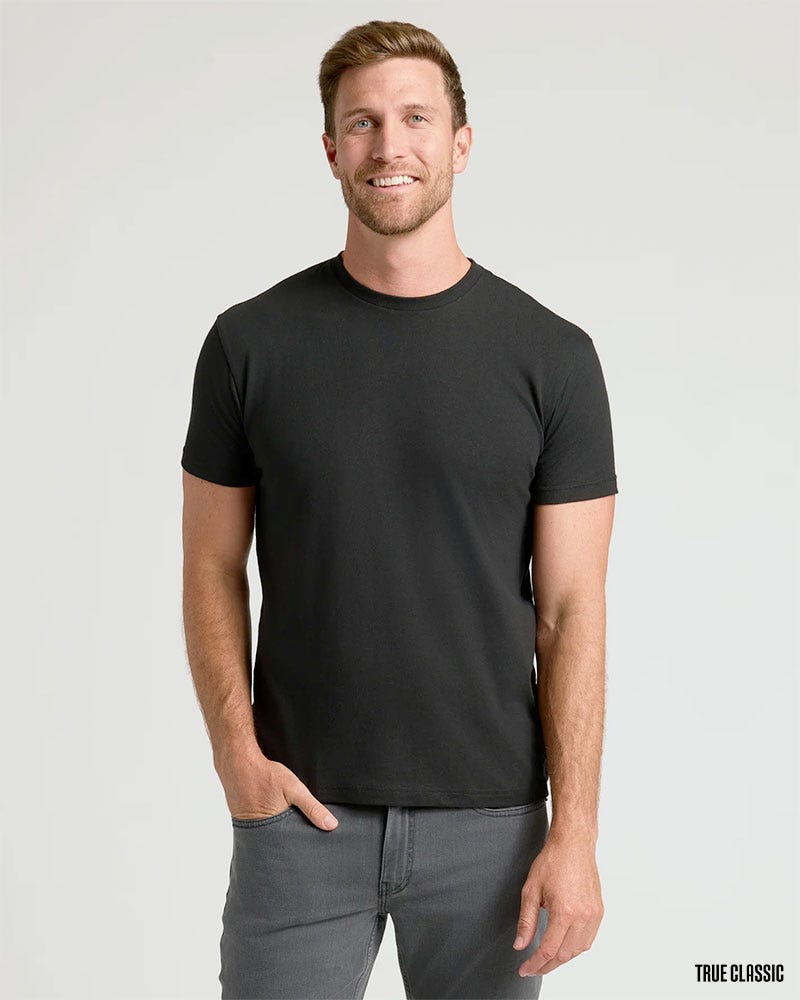
At some point I came across the True Classic brand. The shirts looked right. The descriptions sounded right. Side seams. Cotton blend. A little more weight to them.
Nothing fancy. Just reasonable.
So I tested it. Ordered three black tees.
They showed up. Right size. Right color. The weight was good. The fit was good.
So I thought, fine. This works.
And I ordered more.
Where It Breaks
The next order was ten shirts. Half black. Half mixed colors. They were supposed to show up in a few days. They didn’t. They showed up late.
Not the end of the world.
I threw one on in a hurry and thought it felt a little off. A little big.
Didn’t think much of it until I got home and looked in the mirror.
This wasn’t a Medium.
Checked the tag. Large.
Checked the rest of them. All Large.
Checked the order. I ordered Mediums.
So now we’re at the point where a company made a simple mistake.
This is where customer service is supposed to do its job.
What Should Have Been Easy
I started the return process. It wasn’t impossible, but it was more involved than it needed to be. Then life got in the way, and a couple of weeks went by.
Somewhere in there I made a decision.
I wasn’t going to bother sending them back since that involved a 36-mile roundtrip.
I donated the shirts to a local charity and moved forward. I decided to place a larger order—twenty shirts—and just be done with it.
I made one simple request: no white shirts. Black, gray, navy. That’s it.
I laid it out clearly:
“If you’re able to fulfill a 20-shirt order in the color mix I requested, I’ll proceed immediately.”
What came back wasn’t a solution.
It was policy.
“We do not have the ability to edit or change a pre-made pack.”
I pushed back. Calmly. Clearly. I pointed out that they had already sent the wrong order, that I had absorbed the cost instead of pushing it back on them, and that I was now placing a larger order.
Didn’t matter.
The response didn’t change.
Eventually they offered a workaround:
Order the shirts individually, send them the order number, and they’d refund the difference later.
Three to five business days.
After their mistake. After I absorbed the loss. After I decided to continue doing business with them.
At that point, it stopped being about shirts.
The Realization
I’ve run into versions of this before. You call somewhere, you wait, you finally get someone, and what you’re dealing with isn’t really a person. It’s a policy. A script. Something that doesn’t bend because it isn’t designed to.
And somewhere in the middle of that back and forth, it hit me:
This is an ice chip off a much larger iceberg.
It would be easy to say this is just one company having a bad day.
It isn’t.
What Actually Changes Anything
Pushing back doesn’t fix it. You can explain yourself perfectly. You can be reasonable. You can lay out exactly why what you’re asking for makes sense.
It doesn’t matter.
You’re not dealing with judgment. You’re dealing with a structure that has no reason to change for you.
It’s not going to be fixed by boycotts. Those don’t last. It’s not going to be fixed by outrage. That burns out.
What happens instead is slower.
People get tired of it.
They stop arguing. They stop explaining. They stop trying to fix it.
They just leave.

One at a time. No announcement. No noise. Just a steady drip of people deciding they’d rather give their money to someone else.
And eventually, that shows up where it matters.
Where I Landed
At some point it becomes obvious the only thing that moves anything is whether you stay or go.
So you go.
I’m done.
I’ll find someone who wants my business.
And when this happens to you, you should go, too. Because until it shows up where it actually hurts—their bottom line—they’re not going to change a damn thing.
— Lawrence